Tuesday, 30 August 2016

Index

Many thanks for visiting this website!

Here you'll find some math & football problems. Surely you'll have fun and entertainment with them.

Which one will you pick up first?


All the published puzzles


Websites you can see when you're tired about Mathematics


Monday, 28 December 2015

2015 summary


A summary of the posts issued in 2015. I hope you enjoyed them all.
First of all, I want to thank you for being there one more year.

In this 12 months we have practised some new mathematical issues. I hope you have enjoyed them.

Here you have a list of the posts of this year 2015:

  • Flavius Josephus and the puisi-nanoq game.

    We started the year in Greenland, among seals and bears, with a puzzle about modular arithmetic in which we discovered the Flavius Josephus problem.


  • A galactic prize.

    Later we traveled to the far west, to try to build enormous numbers with a few figures. This entry was rewarded with the first prize of the mathematical Spanish contest "Edición 6.2 Número Pi" del Carnaval de Matemáticas.


  • The awkward question.

    We went to Guanzhong, in China, where we learnt some mathematical methods to ask questions about awkward issues.


  • Sabotage in the stores.

    We returned to Madrid, to face a problem of simplification.


  • Spirals and roulettes.

    And to close the season, we take a quick look at the spirals and helices at Monaco.

I hope that next year you'll also visit my blog. And that you will enjoy my new issues. Thank you very much. I wish you a happy 2016!


Sunday, 20 December 2015

Spirals and roulettes


Joe Vitruvius is going to cellebrate a relaxing and cheap New Year's Eve in Monaco.

The end of the year wouldn't be the same without the confettis, such spirals that become helices when we launch them to the air. There are thousands of examples of mathematical curves all around us that we hardly notice: Archimedes spirals, logarithmic spirals, spirals of Fermat... if we talk about two dimensions. And cylindrical, conical, spherical helices... if we think in three dimensions. Before midnight, several of these curves will get in the path of Joe Vitruvius.

(This post participates on the 130th edition of the Carnival de Mathematics, hosted by the blog Bit-player.)

FIRST HALF

If balls are not found, they should play a bridge game, for instance. The teams of AS Monaco and Las Vegas Mobsters are going to play a charity match on New Year's Eve, for helping the victims of Monte Carlo method.

Players jump into the pitch to start the training session before the match, when the delegate of the club realizes that there are no balls.

The club's kit man has gone off on holidays, so the delegate is about to pick up the keys of the material store from his office, but instead of keys, he finds a Christmas album hanging on the hanger. He tries to telephone him, but there is no way to contact the kit man.

He's a person who likes mind traps, so the disk may represent not only his New Year's greeting to his peers, but also some kind of clue to find the keys.

It seems to me that this kit man is very strange. Couldn't he have written a Christmas card, like everybody? Joe Vitruvius has come to the stadium to watch the game, so the chairman invites him to go down with him to the locker room to see if they can solve the problem.

- Wow, an album of U2! New Year's Day! What a beautiful song to celebrate the New Year!

- Yes, but it would be even more beautiful if it was a key. We can't open the door of the room where we store the balls, with this disk.

- And what do you want me to do? It would be better to call a locksmith.

- Yes, but today is New Year's Eve, and there is no open shop. We will not find any locksmith who wants to come to unlock the door before the time of the start of the match is over.

- I know nothing about how to open locked doors...

- But you know a lot about mind puzzles. And we are convinced that the disk is one of them. In addition, the kit man loves Maths, so we're sure that the album must represent a mathematical clue.


I calculate, therefore I am


SECOND HALF


It was very lucky that they still keep an old gadget. - Have you tried to play the disk just to see if it includes any recorded message indicating the place where he has left keys?

- Luckily we still have an old record player in the office. We played the album, and the only we heard is the song. It's very strange that he used a vinyl record, instead of something more modern such as a CD or a digital format.

- Maybe this is the clue.

- Oh, yes?

- Yes, it's possible. Do you know how a vinyl record is recorded?

- Not entirely.

I was never able to remove the lints clinged to the disk because of the static electricity. - Unlike compact disks, the information in vinyl disks is recorded in a single track. It's a spiral track, that a needle reads moving from the edge of disk to its center.

- So it's only one single groove, right?

- In fact, this type of curve has a special name in Mathematics. It's called Archimedean spiral, as this ancient wise Greek man described it in his treatises.

- Were there music albums in those days?

- No. Archimedes used this spiral for his studies of squaring the circle.

- And has it got any other uses?

- Of course. It has multiple applications. It's used in the mechanisms of air conditioning, in certain tests for the diagnosis of neurological diseases, to calculate the concentrations of bacteria, or for really important issues such as counting the meters of toilet paper on a roll, for example.

- I see. I imagine that the formulas used for its description will be very complex, right?

- It depends. If we define it with polar coordinates (r,θ), the expression we have is very simple:

r = a + b·θ

- It's true, it seems simple, but I don't understand anything.

A spiral thanks to the El Zombie de Shcröndiger.
- The formula says that the distance (r) of each point of the curve from the origin, depends on the turns (θ) and on a coefficient (b). The larger this coefficient is, the greater the distance between the turns of the spiral.

- Well, it was not that complicated. But I think we are giving around the bush like in an Archimedean spiral, without actually any conclusion.

- Well, I think we should search for somewhere in the stadium where we can find another spiral of Archimedes.

- Hmmm. I don't know.

- I think that, at the entrance, I saw a magnificent Christmas tree. I've noticed the lights arrangement, and I saw that they formed a perfect spiral of Archimedes.

- Oh, yes?

- Well, not exactly. It would be rather a conical helix, as it is a continuous curve which develops in three dimensions. But if we look at the tree from above, and project the helix in only two dimensions, we would see that the lights are arranged according to an Archimedean spiral.

An amazing zenital picture of the stadium. But I can't distinguish anything.Now we can see perfectly the amazing Arquimedean spiral formed by the lights, and the numbered balls.

- Who put up this tree?

- The kit man.

- Well, we're approaching the solution.

- But where can he have hidden the keys? Hanging from a branch?

- I don`t think so. They may be within any of the balls that adorn the tree. If you look, at them, all have a number.

- Yes, but which ball will we choose? We have no time to break all the balls to see if we find the keys within any of them.

Place your bets, ladies and gentlemen! No more bets! - He hasn't left us more clues, except the disk with the Archimedean spiral. So we should focus in it. This spiral is also known by another name: Archimedean roulette...

- Ah! Now that you mention it, I remember that before he worked for our club, he was employed as a croupier at the Grand Casino. Perhaps there is some sort of relationship with the roulette you say.

- Certainly. The roulette is a game invented by the Mathematician Blaise Pascal, who established its rules on the 17th century. This rules haven't experienced any outstanding change since then. The most important new was introduced to include, among the 36 existing numbers, the red and black ones, an extra green number, zero, exclusive for the casino, which allows it to get some profits.

- Given that he worked as a croupier at the casino, perhaps we should then open the ball number 37.

- What an ugly number!

- There are no ugly numbers. For example, 37 is a fascinating number, because it's a prime number that is factor of all three-digit repdigit numbers.

- Repdigit numbers?

- Yes, numbers that are composed by repetition of the same figure: 111, 222, 333...
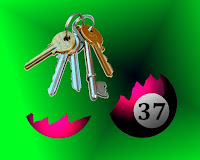
Number 37 was deserving a good tribute. - Ah! It's okay. Let's try with ball number 37.

- Correct: here are the keys! Go quickly to open the door and get the balls so that the match can be played.

- And we're going to the VIP box to open a few bottles to celebrate the resolution of the problem, and to wish all our followers a Happy New Year!


Thanks for joining my blog for another year. I wish you an extraordinary year 2016!


If you want to know more about the content of this post, you can also look at these amazing articles: From physics to online fun: The history of Roulette, Spirals, Arquimedean spiral, Polar and Cartesian Coordinates.


And don't forget to take a walk by the 130th Carnival of Mathematics. There you'll find lots of excellent math posts that you'll surely like too.

Monday, 28 September 2015

Sabotage in the stores


Joe Vitruvius and Madrid nightlife

The method of simplifying consists on transforming one expression into another one simpler, more useful to work, or easier to memorize. We simplify fractions, polynomials, powers and radicals... It's a great Mathematical tool, but it can become a dangerous method if you don't use it properly.


(This post participates on the 127th edition of the Carnival de Mathematics, hosted by the blog Mathematics and Coding.)

FIRST HALF

Iker Casillas signs for PortoReal Madrid president feels anxious. He’s not able to balance the books of the sales in the stores.

After the signing of Iker Casillas for Porto, Florentino wants to clear the stock of the goalkeeper t-shirts as soon as possible.

To achieve this, he has instructed the two official stores. In the store closer to the Santiago Bernabeu stadium, they will sell 2 t-shirts for 20 € in total, while in the other store, the deal will be 3 t-shirts for 20 €.

In the first week, they have sold a total of 6,000 t-shirts, 3,000 in each store. In total, they have made 50,000 €.

But there are still many shirts to sell, so in the second week they have decided to change the offer.

If the previous week they sold 2 units for 20 euros and another 3 units for 20 euros, now both stores will sell batches of 5 t-shirts for 40 euros, and will get the same income for every 5 t-shirts.

Iker t-shirts on sale

During the second week, they have managed to sell the same number of shirts (6,000), also 3,000 in both stores, but the takings have dropped to 48,000 euros.

The club doesn’t understand why they have got less money. They think that maybe an employee of one of the stores has stolen some notes.

Cash register The fact is that there are still 6,000 Iker t-shirts to sell. This time it's been decided a different deal. They’ll sell batches of 3 units for 15 euros at the shop of the stadium, and batches of 2 units for 25 euros at the store of Gran Vía. Thus, for every 5 shirts they will get again a total of 40 euros.

Finally, they sold the remaining 6,000 shirts, 3,000 in each store again. But this time they get 52,500 euros.

Now the board of directors doesn't understand anything. It’s possible that the employee who stole 2,000 euros last week has returned them to the cash desk, or maybe the money was miscounted last week. But then, what about the extra 500 euros of the third week?

Undoubtedly, this is a mystery that only Joe Vitruvius can solve, so Florentino calls him to come and to solve the enigma.


I calculate, therefore I am


SECOND HALF


Joe Vitruvius with Florentino - Hi, Florentino, how are you?

- Well, we’ve got a small problem. We sold 18,000 t-shirts over the past few weeks. We have asked 40 € for every 5 shirts, so we should have entered 144,000 euros. And yet, we got 6,500 euros more.

- That's fine. With that extra money you can sign a new goalkeeper, right? Or you can also buy a next-generation fax...

- The thing is that during the last three weeks we have sold the same number of t-shirts and yet, every week we have cashed up a different amount of money.

- I see. Were all units sold at the same price?

- No. We have two stores, and each one had a different offer.

Shops at Gran Vía and near Santiago Bernabéu stadium

- Well, it may explain everything.

- No, because for every 5 t-shirts, the money extra we get in one store equals the money we lose in the other.
Batches of 5 Iker t-shirts

- Then it's clear. You've sold more t-shirts in the store where you have a better deal. That’s the difference.

- Not either. It turns out that despite the offer, we sold the same number of shirts in both shops. So the differences weren't because we sold more shirts in the cheapest store.

I think that there is an employee who wants to turn us crazy with this, perhaps a staunch supporter of Iker who didn’t like him to leave Real Madrid, or something like this. I would like to find the saboteur.

- Well, I think that such a person doesn’t exist. It's just a small mathematical paradox, because of the simplification on the calculus.

- Oh yeah? What is it about?

- Let’s see. We’ll start with the central week, in which both stores sold batches of 5 t-shirts for 40 euros. If 6,000 shirts were sold in total, we can say that 1,200 batches of 5 units were sold, or what is the same, you sold t-shirts for 8 euros, right?

Sales distribution between the two stores


- Yes, I think it's pretty clear.

- Now let's see what happened on the first week.

8 euros an Iker t-shirt - Then we also sold batches of 5 t-shirts for 40 euros. In the store close to the stadium we sold 2 t-shirts for 20 euros, and in Gran Vía we sold the remaining 3 shirts for 20 euros.

- There's the trap. In this case we can’t talk about batches of 5 shirts, since it’s not entirely true. You are wrongly simplifying the distribution of your sales.

- Why?

- In each store you sold 3,000 shirts, right?

- Certainly.

- In this case we can only speak of 1,000 batches of 5 t-shirts (sold at an average of 8 euros each unit). And a surplus of 1,000 t-shirts, which were sold in the store close to the Bernabeu stadium at 2 shirts for 20 euros, ie 10 euros per t-shirt.

Therefore, part of the t-shirts were sold at a higher price. That’s why you got an additional money during the first week.

Sales distribution between the two stores


- And if you look at the last week, we can see that a total of 1,000 batches of 5 t-shirts were sold for a total of 40 euros (at an average of 8 euros a t-shirt). And there were still 1,000 t-shirts in the store of Gran Vía, which were sold at 2 units for 25 €, ie 12.5 euros per shirt.

And that's why this week you got even more money.


Sales distribution between the two stores

- Now I understand everything. So there is no saboteur...

- Nope. The error was that you thought that the t-shirts were sold in batches of 5 units all the time, when it happened only one week.

- And has this ever happened elsewhere?

- Yes. The writer Malba Tahan, in his book 'The man who counted', writes a case just like this with some pineapple vendors. And Martin Gardner, on his book 'Aha! Gotcha. Paradoxes to puzzle and delight', shows a similar case which takes places in a music store.
Recreational Mathematics-OK, now I stay calmer. We'll have to see what we can do with the extra money we have got.

- Well, you can give the extra money to any philanthropic association. Or you can also buy some books of recreational mathematics, and give them to the children who come to the stadium, at the beginning of the next match. Surely you will increase the attendance to the stadium.

- We will think about it. Bye, Joe, and thank you very much for your help.

- Till next time, Florentino.


And don't forget to take a walk by the 127th Carnival of Mathematics. There you'll find lots of excellent math posts that you'll surely like too.