Showing posts with label mean. Show all posts

Tuesday, 30 September 2014

An impossible transfer

A football agent burdened by failing to make any transfer during the summer, suddenly comes across a unique opportunity. The problem is that the acquiring team and the selling team have seemingly opposing interests. Will he be able to please both sides? The Will Rogers phenomenon and the game theory.
FIRST HALF

Will Rogers phenomenon
It's been an awful summer for Klaus Händler.

Klaus is a football agent, and during the last months none of the transfers that he has negotiated has come to a successful conclusion.

Some clubs he works with have no money for signing new players because of the economic crisis, and moreover, some of the players he represents are injured.

He's thinking he'll have to sell some of his dearest Lamborghini cars to afford the expenses of his comfortable life style during this winter, while, suddenly, the phone rings.

Selection of wonderful luxury car of the marca Lamborghini

FC Schalke 04 badge
It's Josef, chairman of the FC Schalke 04:

- Klaus, just now we've got 5 forwards in our team, and we want to transfer one of them. Could you take charge of it?

Just after hanging up the phone, it rings again. This time it's Michael, chairman of the Bayer 04 Leverkusen:

Bayer 04 Leverkussen badge
- Klaus, how are you? I call you because today is the transfer deadline day, and we want to sign one additional forward...

It looks like Klaus won't have to sell his luxury cars...

But there's a problem. Both teams are interested in increasing the average goal-scoring ability of their forward line and, at the same time, reducing the average wage of their players.

Increasing the average scoring ability and reducing the average wages at a time

Klaus phones some teams, to see if it's possible any agreement, but all the teams have completed their playing staffs.

It seems clear that it's not possible to transfer a forward from Schalke to Bayer, because of the imposed conditions by both teams. So, what can Klaus do? Could we help him in some way?


SECOND HALF
Joe Vitruvius
Klaus has decided to call his friend Joe Vitruvius, to see if he can help with this apparently unsolvable problem.

- Joe, I think that if we transfer one player from Schalke 04 to Bayer Leverkussen, the goal-scoring average of Bayer will rise at the same rate as Schalke's average decreases. And, in same way, the average wage of Bayer will go up at the same rate as the Schalke's average goes down.

Everything a team loses, the other wins it

- So, you think that everything a team gets, the other loses it. That's what we know as zero-sum game in mathematical game theory. But it's not always like this. As in real life, we can find situations in which all parts win or lose (non-zero-sum games).

- Yes, but I don't think this is one of the times it works.

- Well, we can try it. You told me that both teams want to increase the average goal-scoring ability of their forward line, and at the same time, reduce their average wage, didn't you?

Increase the average goal-scoring level and reduce the average wage at the same time.

- Yes, that's right.

- if we talk in absolute values, there's no way of doing it. But as we talk about averages, it may be possible. Can you give me the data of goals and salaries of the forwards of the two teams?

- Yes, of course. Here you are.

Salaries and goals of Schalke 04's forwards

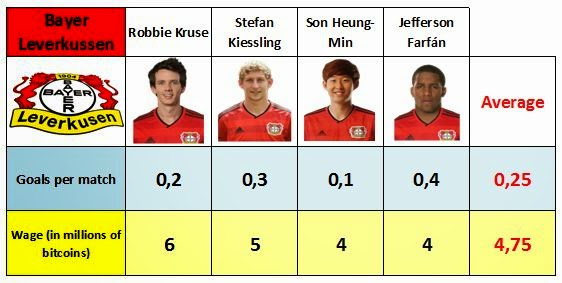
Salaries and goals of Bayer 04 Leverkussen's forwards

- Well, let's calculate the means of goals and wages of both forward lines.
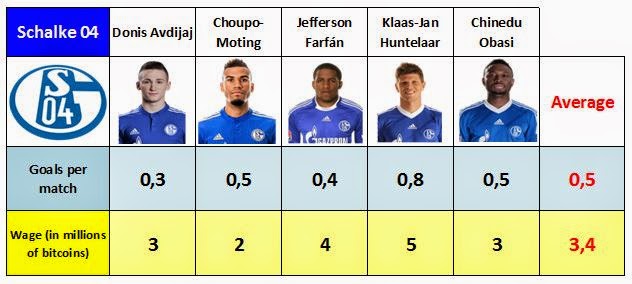
Data and averages of wages and goals of the Schalke 04's forwards
Data and averages of wages and goals of the Bayer 04 Leverkussen's forwards
- Now we can verify if there's a solution for your problem. We only have to apply the Will Rogers phenomenon.
Will Rogers, an American humorist
- And... what's that about?

- This paradox is related to a comment that Will Rogers, an American artist, said in the early 20th century: “When the Okies left Oklahoma and moved to California, they raised the average intelligence level in both states".

- He meant that when the citizens from Oklahoma move to California are the less intelligent persons of their state, even so they're more intelligent than California inhabitants, right?

Moving from Oklahoma to California

- That's right. This way, any inhabitant from Oklahoma whose intelligence is under the state average, that moves to California, makes that the average intelligence levels of both states experience an increment.

- And how can we apply it to our case?

- Well. Let's look at the Schalke 04 player, the Peruvian Jefferson Farfán. His goal-scoring ability is smaller than the team's average, but his salary is higher than his teammates average. However, he scores more goals than Bayer Leverkussen's forwards, and earns less money than them.

Comparison of the salary, and goal-scoring capacity of Jefferson Farfán vs. Schalke 04 levels
Comparison of the salary, and goal-scoring capacity of Jefferson Farfán vs. Schalke 04 Bayer Leverkussen levels

- I understand. If we transfer the player from one team to the other, assuming that he will earn the same, and that he will score the same goals, both teams will improve their statistics.

- That's right. Let's see how it works on the table.

Average wages and goal-scorings of Schalke 04's forwards after the transfer of Jefferson Farfán
Average wages and goal-scorings of Bayer 1904 Leverkussen's forwards after the transfer of Jefferson Farfán

- Indeed, both teams have improved their average goal-scoring level, and have reduced their average wages. And does this happen always?

Succulent and tipical German food
- No, not ever. But sometimes it does, like in this case.

- Well, you've just solved my economics this winter. I would have to invite you to a good meal…

- I think this will cost you more than a simple meal. I prefer we do the following deal: you'll pay me in function of the goals that Jefferson scores this season. If he scores only one goal, you'll pay me 2 bitcoins. If he scores 2, you'll double the amount, 4 bitcoins. If he scores 3 goals, I will receive the double, that is, 8 bitcoins. And so on.

- That seems a fair deal. I agree.

Jefferson Farfán scoring a goal for Bayer Leverkussen.

The transfer was done. Schalke sold one of its excedent players, Bayer signed an extraordinary forward, and Klaus didn't have to get rid of his precious Lamborghini automobiles. At least during this winter, because Farfán scored 25 goles for his new team…

Can you calculate how many bitcoins Joe Vitruvius received from Klaus Händler at the end of the football season?

Some bitcoins, one of the internet virtual coins

If you're interested in learning more about this topic of the Will Rogers phenomenon and about the game theory, you can visit any of this magnific articles: The "Will Rogers Phenomenon" lets you save lives by doing nothing, The Will Rogers phenomenon, Game Theory and the Nash Equilibrium, Evolutionary Game Theory, Advanced Game Theory Overview,

Below this lines  you will find other links, for if you liked this story and you want to share it with your friends.

And don't forget to take a walk by the Carnival of Mathematics. There you'll find lots of excellent math posts that you'll surely like too.

Thursday, 24 October 2013

Breakfast at Les Deux Magots


FIRST HALF
Zlatan Ibrahimovic intrigued by the friendship paradox
(This entry participates on the 104th edition of the Carnival of Mathematics hosted by Math-Frolic!)

Zlatan Ibrahimovic is sad, very sad. This is because he thinks he has few friends among his teammates. 

When he takes a look at his companions, he realizes that most of his friends have more friends than him. And not only in the pitch or in the locker room, but they also have more followers and friends in social networks (Facebook , Twitter, Linkedin, Google+...). 

Awesome continental breakfastHe has proposed himself the firm intention to change this situation, and he's looking for someone to give him advice on how to make more friends. So he meets with Thiago Silva at Les Deux Magots to have breakfast and talk about it.

Restaurant Les Deux Magots, Paris.It 's a lovely day in Paris, so Zlatan and Thiago sit outside to have a nice breakfast. Zlatan exposes the problem to Thiago:

My friends seem so much more popular than me. I've noticed that they've got more friends, and I'd like to do anything to have so many friends as them. 


Thiago Silva talks as follows:

You shouldn’t worry about what you’re saying. It's very common, it's not your fault, it's just Maths. 

Do you think that it’s also the fault of Mathematics? Think a moment, and pass to see the solution in the second half.


SECOND HALF

Thiago Silva about to explain to Ibra the friendship paradox.
Well, as Thiago Silva says, it’s a simple mathematical problem, and not otherwise. Let's see how Thiago explains it to Ibra:

Do you know the friendship paradox?  According to it, your friends have more chances of having more friends than you do...

Well, once I heard that people usually are more likely to be friends with those people who have many friends than with those with few friends ...

Yes, that’s what Satoshi Kanazawa psychologist said: people use to establish friendship more often with people who have many friends that with those which have few. Although it doesn’t match exactly with this problem; we should rather look at the studies of Feld sociologist.

Is this Feld the one who discovered the friendship paradox?

Yes. Indeed, Feld’s frienshid paradox is a property of Graph Theory, by which it’s established that it’s likely that our friends have more friends than we have...

List of the 11 lineup players of the Paris Saint Germain team.How is it possible?

Thiago picks up a notebook and begins to put on paper all the team’s friendship relations.

Let's see it graphically. We’ll write in this paper the 11 lineup players (list on the right).
Now, we'll identify the players with a blue circle (vertices), and we'll write inside them their numbers. We'll connect with a red line (edges) the circles of those who are friends.

Beside each player we'll write in lilac a figure representing the number of friends he has (just counting the number of red lines from his circle). That way we can see graphically all existing friendship relations on the team.

As you can see, you are the blue circle with number 10 inside it. There’re 3 red lines connecting your circle with your 3 friends: Pastore (27), Lucas (29) and Lavezzi (22). That’s why I wrote a lilac color number 3 beside your circle, because you’ve got 3 friends.

Graph of the friendship relations among the players.

Now we’re going to build a table from this graph. In the line corresponding to each player we’ll write the total of friends of each player’s friends in the cells where his row crosses with his friends' columns. In the table beside, in the first column we’ll put the amount of friends each player has. In the second one we’ll add up all his friends’ friends. And in the third one we’ll calculate the friends average of his friends, by dividing the sum of the friends of the friends by the number of friends.


Table of the friendship relations among the players.

Let's go first with you, Ibra. You're number 10. Look at row 10: you've got 3 friends: Lavezzi (22), Lucas (29) and Pastore (27). Lavezzi (22) has 3 friends, so we've written a 3 in the cell where your row (10) meets his column (22). Lucas (29) has got 7 friends, so we write a 7 in the cell where your row (10) crosses with his column (29). And Pastore (27) has got 2 friends, so we've written a 2 in the correspondent cell.

We’ll do it that way with all the players, and now we fix our attention to the table on the right.


If we pay our attention to how many players have more friends than the average of their friends, we get, surprisingly, that only 3 of them (23, 2 y 29, in red color) have more friends than the average of their friends (number on third column is greater than number on first column), and the remaining 8 have fewer friends. And as we can see, the total average of the friends  


42 / 11 = 3.82 

is much lower than the total average of the friends of the friends.

182 / 42 = 4.33

Why does this happen?

This has to do with the properties of the geometric mean and the statistical variance. Let's take another paper, and we’ll focus only on the friendship relations among the 4 defenders.

Graph of the friendship relations among the defenders.

We notice that Van der Wiel (23) has got 2 friends, Jallet (26) has 2 friends, Maxwell (17) has got only 1 friend, and I, Thiago (2), have got 3 friends.

We calculate the friends average of the defenders: (3+2+2+1)/4 = 2. We can see that defenders have 2 friends each one by average.

Table of the friendship relations among the defenders.

Now we’ll calculate the friends mean of the defenders’ friends. Van der Wiel (23) has 2 friends, who have 2 and 3 friends, respectively. Jallet (26) has got 2 friends, who have 2 and 3 friends. Maxwell (17) has one friend, who has 3 friends. And I (2) have got three friends, with 2, 2 and 1 friend, respectively.

Thus, we’ve got the following data:

2, 3, 2, 3, 2, 2, 1, 3. 

We sort them like this:

3, 3, 3, 2, 2, 2, 2, 1

And we calculate their average:

(3+3+3 + 2+2 + 2+2 + 1) / 8 = 
(3·3 + 2·2 + 2·2 + 1·1) / 8 =
(32 + 22 + 22 + 12) / 8 = 
2.25

We see how, in a seemingly amazing way, the friends average of defenders’ friends rises up to 2.25, higher than the friends average of defenders we calculated before, which was 2.

That’s true. And always happens the same?

Yes, always. Unless everyone has the same number of friends. In that case the two means are identical.

And why is this happening?

I suppose you've noticed that, when I calculated the mean of friends of friends, I rearranged the data we had in a special order.

2, 3, 2, 3, 2, 2, 1, 3   →   3, 3, 3, 2, 2, 2, 2, 1

Yes, I've noticed it. Why did you do that?

I did it this way so you realized the following question: people who have many friends are incorporated many times within the sum, in fact, so many times as friends they have (3 times number 3), while people who have few friends are included less times (1 time number 1). This means that those players who have more friends have also more weigh in the average (3+3+3+2+2+2+2+1), so that the overall mean tends up.

However, in the friends mean, we add only once each number (3+2+2+1), that is, all people have the same weight, both those who have many friends as those who have few.

I think now I understand it, but I’m not sure that one average has to be larger than the other one for that reason.

Well, then let's go to the mathematical proof.

Let's call xi the number of friends player i has, and μ the friends mean of a n-players team, which will be equal to:
Arithmetic mean formula.

Now let's see how we calculate the friends average of the friends. We’ve seen on the example about the defenders that the sum of the friends of friends corresponds to ∑(xi2), and we know that the amount of friendship relations is ∑xi. So the friends mean of the friends, which we name μ' will be:
Formula of the arithmetic mean of the friends of the friends.
Now we need to check if μ is greater than, lesser than, or equal to μ'.

For proving this, we’ll use the formula of the statistical variance (σ2) of a discrete random variable. We know that:
Formula of the statistical variance.
It follows like:
We divide both terms by ∑(xi), and we get:
Comparison between the friends average and the friends average of the friends.
So:
Comparison between the friends average and the friends average of the friends.
In other words: μ' = μ plus a value greater or equal to zero, because both the statistical variance and the friends average are always non-negative.


Therefore, in a group, the friends average of friends will always be greater than or equal to the average of friends.
Comparison between the friends average and the friends average of the friends.
Well, with this mathematical demonstration, you definitely convinced me. And beyond the fact that people to not be depressed by having fewer friends than their friends, have all these studies other applications?

Well, this paradox has many applications in many other areas of life. For example, it's used for the control of diseases. Thereby, our club does blood tests to some players to detect any contagious illness and prevent it. Every month they pick 5 players randomly, and does some clinical tests to them. Can you imagine a better way of improving this monitoring task?

I think that...

No doubt they should pick 5 players randomly, and then ask them each choose a friend. We know these friends of friends have a friends average higher than the initially chosen players, so they’ll also have a much higher chance of being infected, because as they have more friends they are more exposed to infection. This way we get a sample of players more significant than randomly selected.

That's what I was thinking. 

tGym.
That’s the way most schools, hospitals or residential homes use to do their sanitary controls. Other application is for people who go to a gym and lose heart because they see that most people are in better shape than them... This doesn’t happen to us, right Ibra? In this case they should realize that when they take a look at the people who are at the gym, they are extracting a biased sample, since it’s likely that people they see are those who spend more hours there, and consequently are in better physical condition.

We can also apply this paradox to other things. That way, it’s a very useful technique for children who collect photocards of players like us. They may apply the friendship paradox to complete their albums in a better way. Usually, they try to change their repeated cards among his friends. But they almost never achieve to complete their albums.

Football players photocards.


Changing football players photocards.It would be better than they approach a few children randomly selected, and ask them to submit to their friends, because then they’ll meet the most popular children of the school, who have more contacts and are more likely to have those missing stickers. Even though they should take care of not becoming infected of any contagious illness by them…

And you can also understand why, when we go in vacation to the beach, we find that it's usually crowded. What about those empty beaches in the brochures? Once again, it’s very likely that the beach we go is full of people, and not completely deserted, because of this paradox.

So I shouldn’t worry about having so few friends, right?

Not at all. You can see that it happens everywhere. Not only in the Paris Saint Germain, but in all teams: Real Madrid, AC Milan, Manchester United, L.A. Galaxy, Santos, FC Barcelona... And it happens to most players: Cristiano Ronaldo, Neymar, Falcao, Messi ...

Oh, really…? -Ibra asked flashing a shy smile-. I think after these explanations, and as far as it’s lunch time, I should invite you to have lunch at a restaurant a know...


Restaurant in Paris.